FLEET
ART SOCIETY
Artist Summer Workshops
Summer Workshop with Jake Winkle, June 2026
On Saturday 20th June sixteen of us had a great day with Jake, learning a bit about the techniques used to produce his lively animal pictures in watercolour. We started with a black and white spaniel portrait - Jake provided us with tracings so that we could concentrate on getting the painting right without worrying about the drawing.
Although there was a lot of black on the photo, we weren't allowed to use black from the tube, a mixed black having so much more life in it. We started by doing the main features in detail - the nose and the eyes, livening the eyes with a bit of orange and a touch of blue. Once they were complete we moved on to the main blocks of colour, working our way through gastronomic textures - starting with a wash of very pale colour over wetted paper (consommé), then adding slightly more colour (cream texture), moving to thicker paint (yoghurt) and finally the thickest, straight from the tube (marmite). Working like this, from thinner to thicker, we built up the colour without the paint running into the previous layer - or usually it did...
Jake often uses rich colours where they seem pretty neutral to many of us - they certainly livened up the results, so training our eyes to see colour is something we can all have a go at.
The second part of the day was shorter, when we worked on a painting of a hare - short coated, so more difficult. The approach was similar, starting with the facial features but with the fur, Jake broke the neutral fawny colour into patches of brighter colour - like dot pictures, where blue and red dots lead the eye to see green. We ended up with some very colourful hares!
It was hard work, but a thoroughly enjoyable day. Report by Val Atkinson.

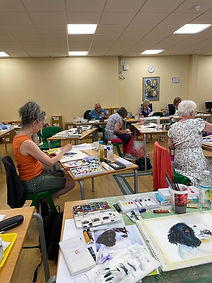


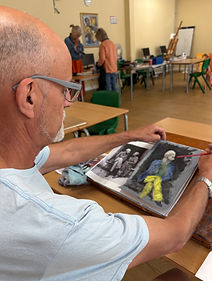
Looking at the day's results
Summer workshop with Ronnie Ireland, July 2026
Ronnie was an engaging, very knowledgable artist and tutor who gave us challenges and interesting tasks, as well as treating us to bonus art history lessons while we worked. The focus of the session was painting figures, mainly in acrylics, which Ronnie demonstrated with, although a couple of people chose other mediums. He showed us how to lay down a neutral background before 'drawing' an outline with the brush. Next he concentrated on tonal values, putting in the main lights and then darks. He showed us how to add thin glazes of light colour over the tonal painting.
While we worked on our own paintings, Ronnie gave advice and tips on how to improve or adjust our drawing, colour and tone, or composition. We had time to work on two of these 'traditional, controlled' figure paintings and then after lunch, Ronnie challenged us to 'let loose' by laying down some random marks with the paint, to 'find a figure' in the marks and develop a painting from there. Some of us found this fun and exhilarating - others found it strange and unsettling - but all had a go. We finished the session by looking at one another's work and Ronnie commenting on the positives he could see in individual pieces. It was a very enjoyable and enlightening workshop.
SE


Review of the day's work
Finding a figure (or two)!
Ronnie's demo
Summer workshop with Catherine McVean, August 2026
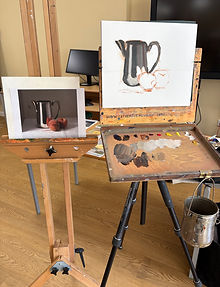
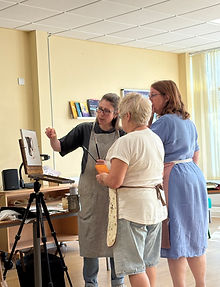
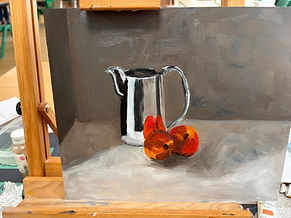
Catherine guided us clearly and methodically through her outstanding technique for painting fruit and reflections of the fruit in a silver jug. She supplied two of her own photographs for a composition with either peaches or pears. At each stage of the painting, Catherine would talk us through and demonstrate each part of the process and then we would work on our own paintings.
She started with drawing the jug and fruit in thin oil paint, measuring how each part related to the other, then she showed how to build up the colours on the jug, starting with the dark areas, then moving into the light, adding white and touches of burnt sienna or yellow to adjust. She checked the mix of her colours on a spare piece of paper, holding it against the photo to check its accuracy. She worked in the same way with the fruit, painting in the most saturated colour area first and adjusting from there, again checking the different hues against the photo.
Finally, the background and foreground cloth were added. She pointed out the cloth was not pure white, so she started mixing the darker, shadow areas first, and then kept adding touches of white to build up to lighter areas. Details such as light highlights on the jug were put in at the end.
The paintings that the group produced were all very successful, as you can see below. There is not space for all of them, unfortunately, but everyone seemed very pleased with their results. A testament to Catherine's excellent tuition!